Seal boxes
Let's find out!
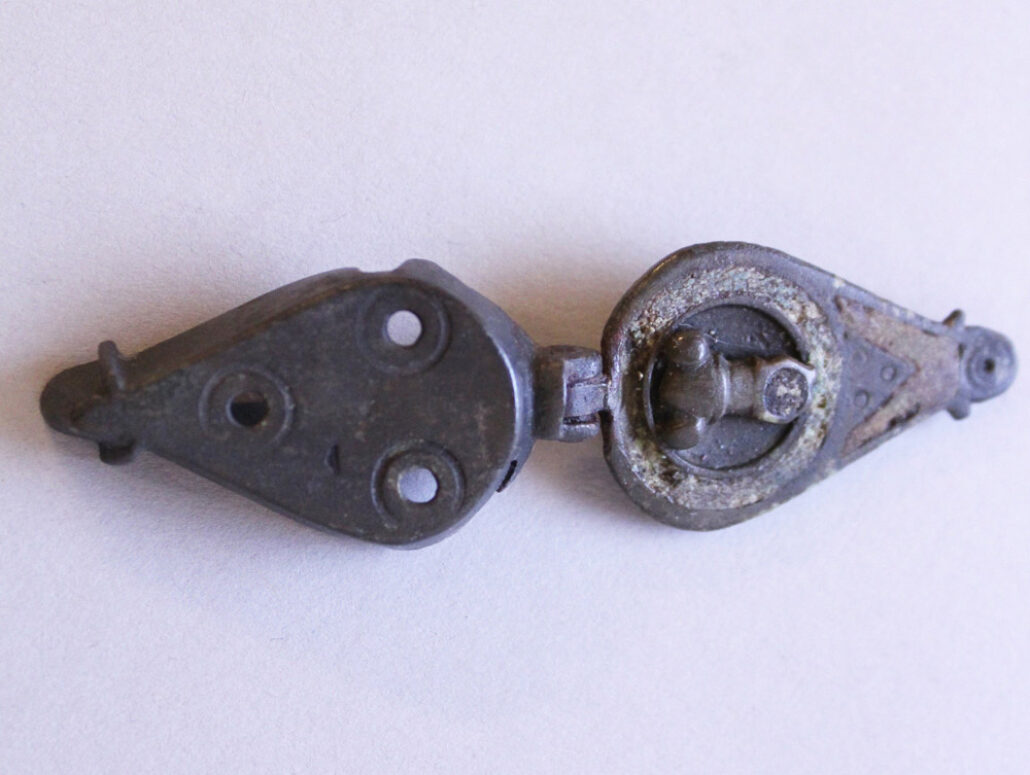
What is this object? A pendant to hold an image of your loved one close to your heart?
No! This object, though the same size, is what’s known as a seal box. This type of artifact, relatively rare, is still little studied. Archaeologists classify it as instrumentum, or “small furniture”.
What does it consist of?
A box, lid, hinges and decoration on the lid form a seal box.
What’s it for?
The seal box is used to protect a wax seal that seals a document to guarantee the confidentiality (and authenticity) of a message. It is used for messages written with a stylus on wax-coated wooden tablets, but could also have been used to secure purses, as has been proposed for finds at Kalkriese and Trier (Germany).
How does it work?
Once the document has been knotted, the link is passed through the box and covered with liquid wax. The seal is made by pressing an engraved or metal-relief intaglio ring onto the wax, leaving the image represented on the ring! Given the size of the box (only 2 to 3 centimeters long!), the bezel of the ring had to be small enough to pass through and press the wax inside.
As you can see from the picture, the bottom of the box has three small holes through which a small amount of wax can pass, probably to help the box adhere better to the support, or to pass other ties to secure the box more firmly to the document.
How do we know?
Archaeologists can identify the use of these objects by studying the way they were made, as well as by traces of sealing wax or fasteners sometimes still present inside the boxes (look closely at the small openings on the sides of the boxes).
Small +
Various methods of sealing documents existed in Roman times. Clay seals, whose tradition goes back much further, were used to seal documents, usually written on papyrus or parchment. Instead of pressing the bezel ring into wax, it is pressed onto a clay pellet which seals a document. The bezel features a design, which can be very varied. Sometimes, the design is described in the document to prove that the letter has not been opened.
When and where?
The use of seal boxes can be traced back to the late Republican and Imperial periods (up to around the3rd century AD). The first boxes were made of bone or copper alloys (bronze, etc.), but metal remained the preferred material thereafter.
These artifacts are mainly found in the northern, northeastern and northwestern zones of the Roman world. One hypothesis put forward by Alex R. Furger is that the use of this type of object is linked to the choice of writing medium according to climatic zone. Wax stamps would be more commonly used in colder, wetter areas, where people would write on wax-coated tablets, and clay stamps in warmer areas, where papyrus is preferred.
And in Nyon?
The Colonia Iulia Equestris has revealed four bronze seal boxes discovered during archaeological excavations in various parts of the city. With the exception of one, all are whole (with the hinge to open the box) and relatively well preserved. On some, enamel decoration can be seen on the ornate side of the lid (outer surface). The green color of these objects is due to the oxidation of the material in its environment. After all, it has been underground for almost two thousand years!
The oldest discovery dates back to 1907, at the Prieuré de Nyon (Inv. MRN/621). The bronze and enamel box is complete and can be opened and closed. It is of the type known as drop-shaped and decorated with a geometric motif. Another box (Inv. MRN/12911-05) of the same shape was discovered near the banks of Nyon, during the 2005 excavations carried out by Archeodunum at La Duche. An erect phallus, often interpreted as a fertility symbol, decorates the lid. This type of representation is one of the most common to be found on such objects in the Roman world. It is particularly common at Augusta Raurica, where the largest corpus (138 Roman seal boxes!) has been unearthed.
Finally, the 1996 excavation of the Nyon amphitheatre unearthed the two other seal boxes known to date from the town of Nyon. These are square in shape, unlike the other two, and appear to be of later date. One retains only its base (Inv. MRN/14106-172), while the other is complete with geometric floral decoration (Inv. MRN/14106-174).
The exact function of these small boxes is still unclear, and not all researchers agree on their interpretation. Some identify them as objects exclusively linked to the military sphere due to their place of discovery, but not all come from this type of archaeological context. Seal boxes found in large urban centers, temples or even in funerary contexts are open to multiple interpretations, and a broader study of this type of object could perhaps tell us more in the future.