Licinius’ 5 bowls
"I'm Licinius'": when five little cups start talking
In an ancient house, a beautiful discovery…
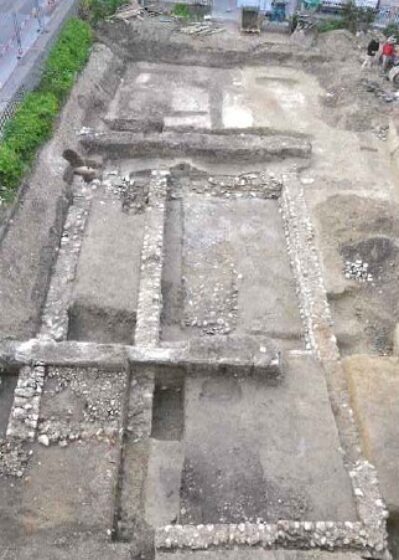
In 1992, excavations in Nyon’s Rue de la Gare uncovered two Roman domus, large houses each occupying a quadrangular block of around 1000m2. Organized around a central porticoed courtyard, these dwellings were commonplace in the agglomerations of the Roman provinces. All within easy reach of the city’s amenities(forum, market, thermal baths, etc.), they must have belonged to a wealthy family from Nyon, who lived there with their slaves and employees.
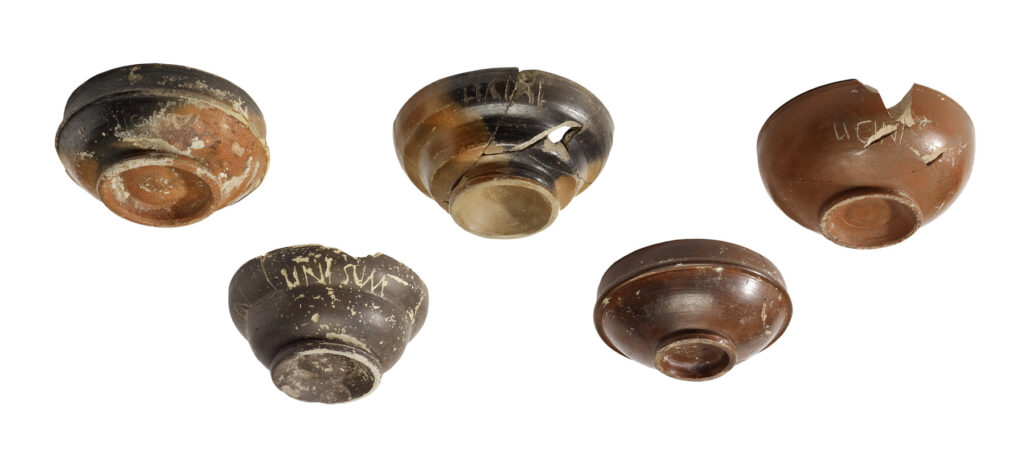
In one of them, beneath the collapse of a mud wall, five small ceramic bowls measuring around eight centimetres in diameter were found. They were undoubtedly stored on or in a piece of wooden furniture that must have collapsed when the wall was destroyed, and which has now disappeared.
Clearly recognizable ceramics
Two of the bowls (the first on the left, top and bottom of the photo) clearly come from the pottery workshops of southern Gaul, known as “terra sigillata” ceramics, recognizable by the bright orange-red color of the coating that covered them. As major production centers, these workshops exported their wares throughout the Roman Empire, all the way to the eastern confines of the Mediterranean. It’s hardly surprising, then, that examples are regularly found in Switzerland.
The other three bowls are similar in shape and size to the previous two. Slightly less finely crafted, they come from local potter’s kilns. In view of the success of the imports, the craftsmen readily adopted the repertoire of Gallic production, which in turn was inspired by Italian terra sigillata. Regional ceramics of this type are called “imitation sigillates” and are produced mainly in Helvetia.
These cups are generally considered to be drinking vessels, probably for wine, a beverage of Roman rather than Gallic tradition. Although wine imported from Italy was appreciated by the Gauls, they traditionally drank mead and cervoise, served in goblets, vases taller than cups and with slightly closed necks.
When ceramics help to date
Ceramic vessels, and in particular terra sigillata, are invaluable markers for archaeologists. As is the case today, Roman tableware was subject to changing fashions, and ceramic production evolved with the passage of time and the skills of craftsmen. Thus, a bowl of a certain type might be produced for several decades before being abandoned in favor of another, more modern shape. Thanks to lengthy comparative studies, it is now possible to date the production period of each type, and this makes it possible to give an often quite precise dating for a set of ceramics.
In the case of the five dishes in the Rue de la Gare, it is likely that their owner assembled his china cabinet during the first half of the1st century AD, and more specifically as early as 30 AD, as one of the shapes was not produced before this date.

When objects speak
Let’s take a closer look at these bowls: two of them are inscribed with a name, Licini “de Licinus”, while two others have a phrase engraved on the side, Li(ci)nus sum “je suis celui de Licinus”. These words were drawn by the owner of the vases, a certain Licinus, who wanted to let the rest of the household know that these cups were indeed his. The fifth bowl bears no graffito, but being part of the same lot, it must certainly have belonged to him too.
Property marks on domestic objects are relatively common, and form part of what archaeologists call “minor inscriptions” or graffiti. According to a recent study (R. Sylvestre, Les graffitis…, 2017), in the city of Avenches alone, 1,828 graffiti of all types were discovered (on ceramics, wall plaster or other supports, school exercises, content indications or votive inscriptions…), including 483 marks of ownership.
Who was this Licinus? Was he one of the house’s owners? Or was he a slave or family employee? Unfortunately, it’s impossible to answer these questions. In fact, there are numerous occurrences of this name in Gaul and even in Rome, and it can refer to Roman citizens as well as slaves, freedmen (former slaves) or peregrines (free men without the rights of a Roman citizen).
Licinus’ identity and status will have to remain a mystery, but we can always imagine him carefully carving his name to avoid having to share his cups with others, as we would today with our personal belongings.